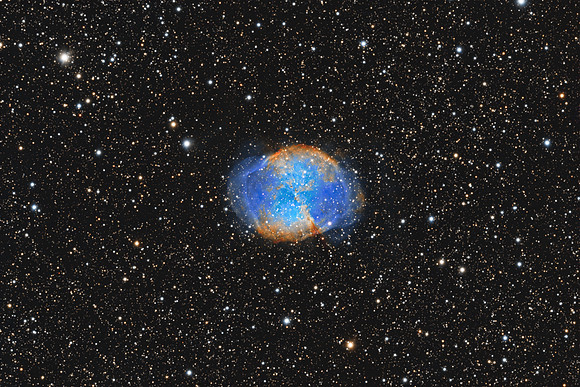
M 27 Dumbell Nebula
It has been a while since I have spent time gazing at the night sky. To get back into things, I chose a target I have photographed previously, which is an easy, bright object. What I am using different is a larger telescope – about twice the focal length I used previously.
Spotted by Charles Messier in 1764, M27 also known as the Dumbbell Nebula, Diabolo Nebula or Apple Core Nebula was the first planetary nebula ever discovered. The term “planetary nebula” is a bit misleading. It is based on the nebula’s round, planet-like appearance when viewed through smaller telescopes.
The nebula is the result of an old star that has shed its outer layers in a glowing display of color.
The Dumbbell Nebula is large and quite bright, which makes it a popular object among amateur astronomers. It can be seen in binoculars and small telescopes. The nebula covers an area of 8 by 5.6 arc minutes (moon is 31 arc minutes) and has a radius of 1.44 light years. M27 lies at an approximate distance of 1,360 light years from Earth and has an apparent magnitude of 7.5 – right on the edge of naked eye visibility. What was happening on earth in 1360 years ago? Well, in Great Britain there was a plague pandemic that devasted the population – smallpox. I guess some things never change….
Messier 27 is the second brightest planetary nebula in the sky, second only to the Helix Nebula in Aquarius (hopefully coming soon to an inbox near you).
The Dumbbell Nebula is in the constellation Vulpecula (The Fox). It can be seen in large binoculars, and some of its details are visible in smaller telescopes. The best time of year to observe M27 is summer as it lies within the Summer Triangle (almost straight up), a asterism in the summer sky formed by the bright stars Altair in Aquila, Vega in Lyra and Deneb in Cygnus – all very bright stars.
Planetary nebulae are what our Sun will produce when it nears the end of its life and nuclear fusion stops in its core (sorry for the spoiler).
This was taken over 2 nights – August 2 and 7 and is 36 x 300 second exposures (3 hours in total).